
Reading time : 9 min | Updated : April 2026
The mountains around Chiang Mai are not empty. They are home to communities that arrived here from Tibet, southern China, and Myanmar over the past two centuries, each carrying their own language, their own spiritual system, their own way of building a house and planting a field. They did not come to Thailand. They came to the mountains, which happened to be in Thailand.
Understanding who these people are, not as an attraction but as distinct civilisations with their own histories and their own futures, changes how you experience the entire north. The weaving at the market stall is not handicraft. It is a language written in thread. The spirit gate at the village entrance is not decoration. It is a boundary between worlds. The silver headdress is not costume. It is identity made visible.
This is a guide to three of the most significant highland communities near Chiang Mai : the Karen, the Akha, and the Hmong. Three peoples, three completely different stories.
The Karen : The People Who Have Always Been Here
The Karen are the largest highland community in Thailand, with approximately 320,000 people representing roughly half of the country's total hill tribe population. The Karen are known to many as Kariang or Yang, and are one of the largest hill tribes in Southeast Asia. Wikipedia
Their relationship with this landscape goes further back than most of the other highland communities. Where the Akha arrived in the early 20th century and the Hmong came in waves through the 19th and 20th centuries, the Karen have been present in the mountains of northern Thailand for several hundred years. Their lower-altitude villages, built from bamboo and teak on stilts, reflect generations of knowledge about how to inhabit a specific ecosystem sustainably.
The Karen are animists by tradition, though many communities have absorbed elements of Buddhism or Christianity over generations. Their spiritual life is oriented around the land : the rivers, the forests, the seasonal cycles of planting and harvest. Their relationship with elephants is not incidental. In Karen culture, the elephant is a working partner and a family member, an animal whose welfare is bound up with the welfare of the community.
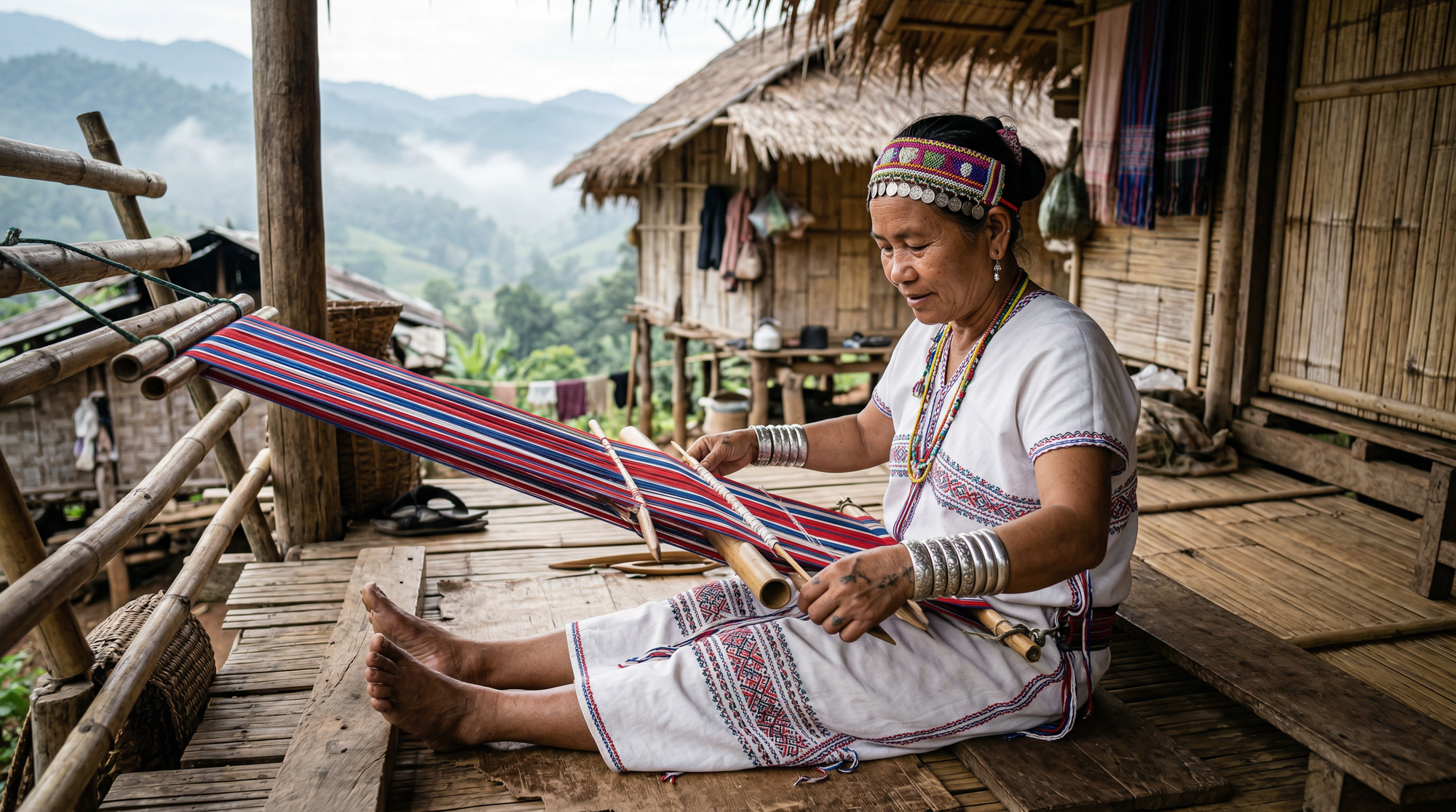
The textile tradition is one of the most visible expressions of Karen identity. The most traditional Karen tribespeople wear silver armbands and a beaded sash and headband, while unmarried women wear white shift dresses. Frommers The weaving patterns are not decorative. They carry information about lineage, community, and the weaver's own place within both. A Karen woman does not produce cloth : she produces autobiography.
The Karen communities closest to Chiang Mai are in the Mae Wang district, about 90 minutes south of the city. The 2-day Doi Inthanon eco-trek with Karen homestay takes you into the Mae Klang Luang Karen village inside Doi Inthanon National Park, with local Karen guides and an overnight stay with a host family. The combination of conservation work, cultural encounter, and summit hiking in a single two-day trip is unusual and well-structured.
The Akha : The People of the Spirit Gates
The Akha arrived in Thailand later than the Karen and live higher in the mountains. There are two to three million Akha and Akha-Hani in total, 70,000 of whom live in Thailand. The Akha speak a language in the Lolo/Yi branch of the Tibeto-Burman language group but have no traditional written language. Wikipedia
The absence of writing is significant. Everything the Akha know, everything their culture contains, is transmitted orally. Verbal storytelling and songs preserve their history and beliefs. Every Akha male can recount his genealogy back over fifty generations to the first Akha. Wikipedia In a culture without books, the memory carries the library.
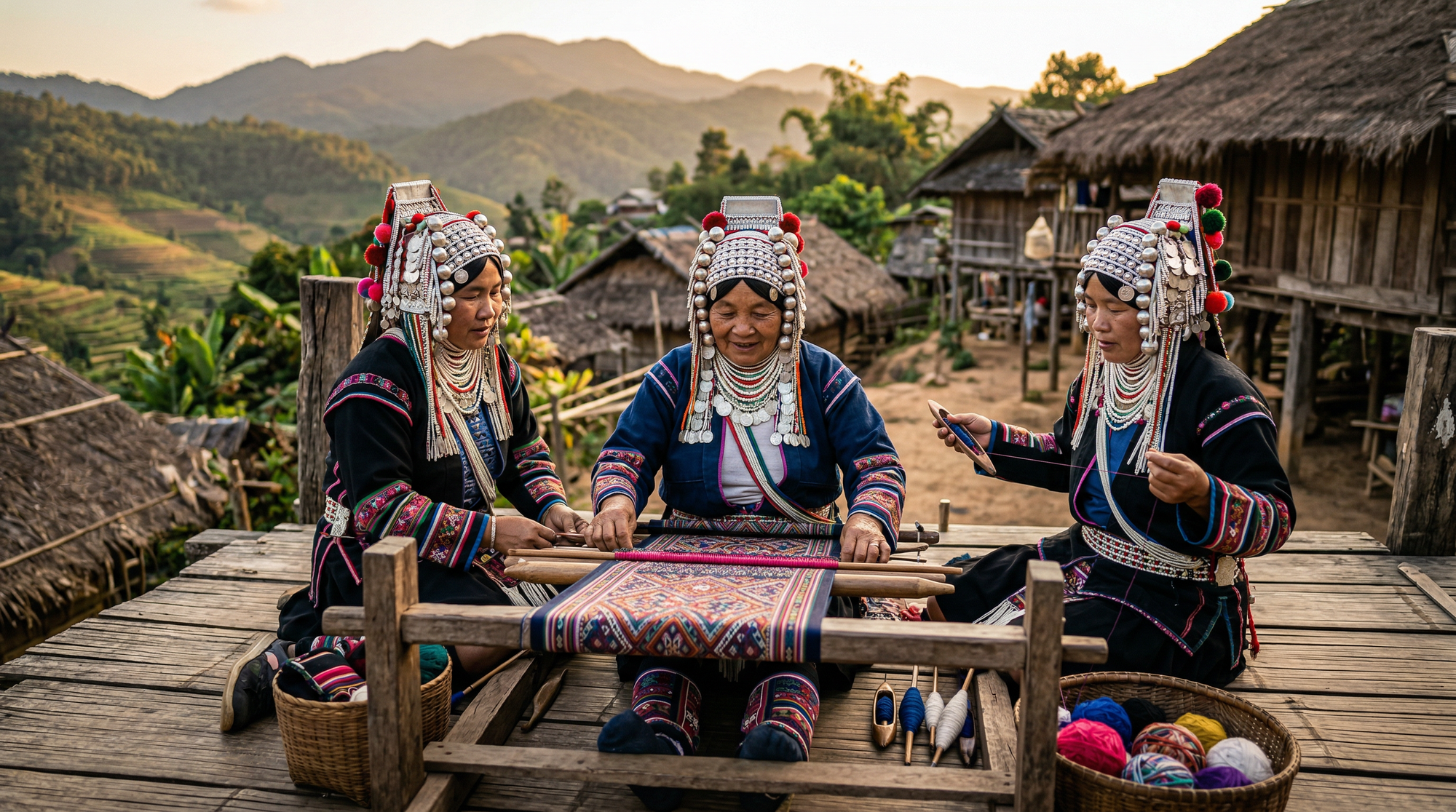
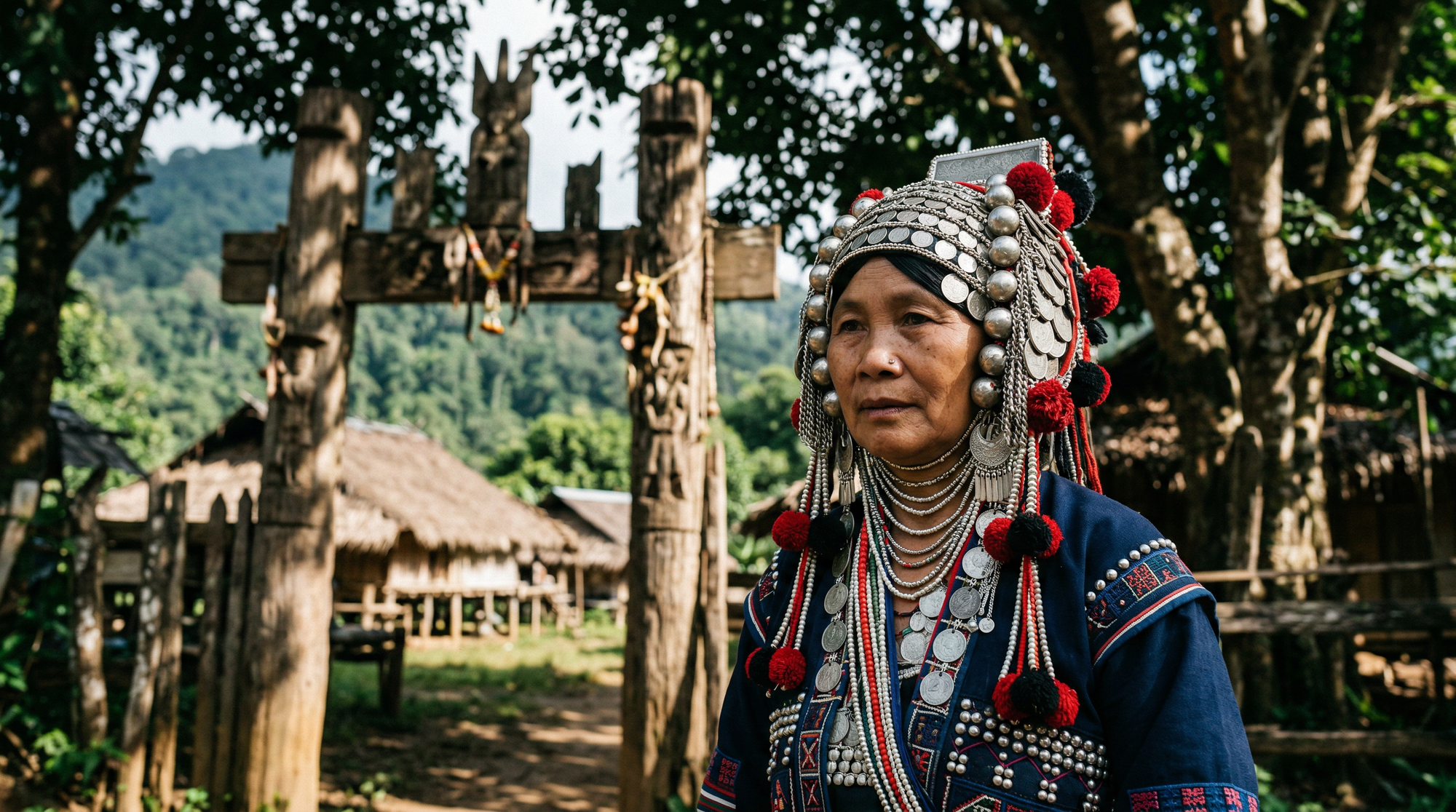
Akha villages are immediately identifiable by two features. The first is the elaborate silver headdresses worn by women, heavy constructions of coins, beads, and worked silver that are among the most visually striking expressions of personal identity in all of highland Southeast Asia. Traditional Akha dress is vibrant and intricate, reflecting cultural identity and social status. Women wear elaborately embroidered jackets, skirts, decorated sashes, and headdresses adorned with silver ornaments.
The second is the spirit gate. Every Akha village has one at its entrance, a wooden structure carved with guardian figures that marks the boundary between the human world and the spirit world. Although many Akha, especially younger people, profess Christianity, Akha Zang, which means the Akha Way, still runs deep in their consciousness. The Akha Way, a prescribed lifestyle derived from religious chants, combines animism, ancestor worship, shamanism and a deep relationship with the land. Wikipedia
The spirit gate is not a tourist feature. It should not be touched. This is not a cultural sensitivity guideline but a straightforward description of what the gate means : it is a sacred object protecting the community from forces that exist outside it. A visitor who touches the gate is not being disrespectful in the abstract. They are, from the Akha perspective, potentially disturbing a protection that the entire village depends on.
Akha villages are primarily in Chiang Rai province, further north than the Karen settlements near Chiang Mai. Reaching them properly requires a multi-day trip and a guide with specific relationships in those communities.
The Hmong : The People Who Carry Their History in Cloth
The Hmong story is one of the most complex and most political of any highland community in Southeast Asia. The majority of the Hmong population in Thailand arrived during the late 19th and early 20th centuries, migrating from Laos and Vietnam, with further waves arriving as refugees following the conflicts in Indochina, where many Hmong had been involved in what is known as the Secret War. Maehongsonholidays
The Secret War refers to the CIA-backed Hmong guerrilla campaign in Laos during the Vietnam War era. When the war ended and the communist Pathet Lao took power, the Hmong who had fought on the American side faced severe reprisals. Tens of thousands fled across the Mekong into Thailand. The communities in the mountains around Chiang Mai and Chiang Rai include people who carry this history in their own lifetimes, not as distant ancestry but as lived experience.
The Hmong are the most commercially astute of all the hill tribes of Thailand. Their villages can be instantly recognised by their ground-level wooden houses, unlike the raised stilt bamboo houses of other tribes. ThailandhilltribeholidaysThis architectural difference reflects their origin in southern China, where cooler temperatures made ground-level construction practical.
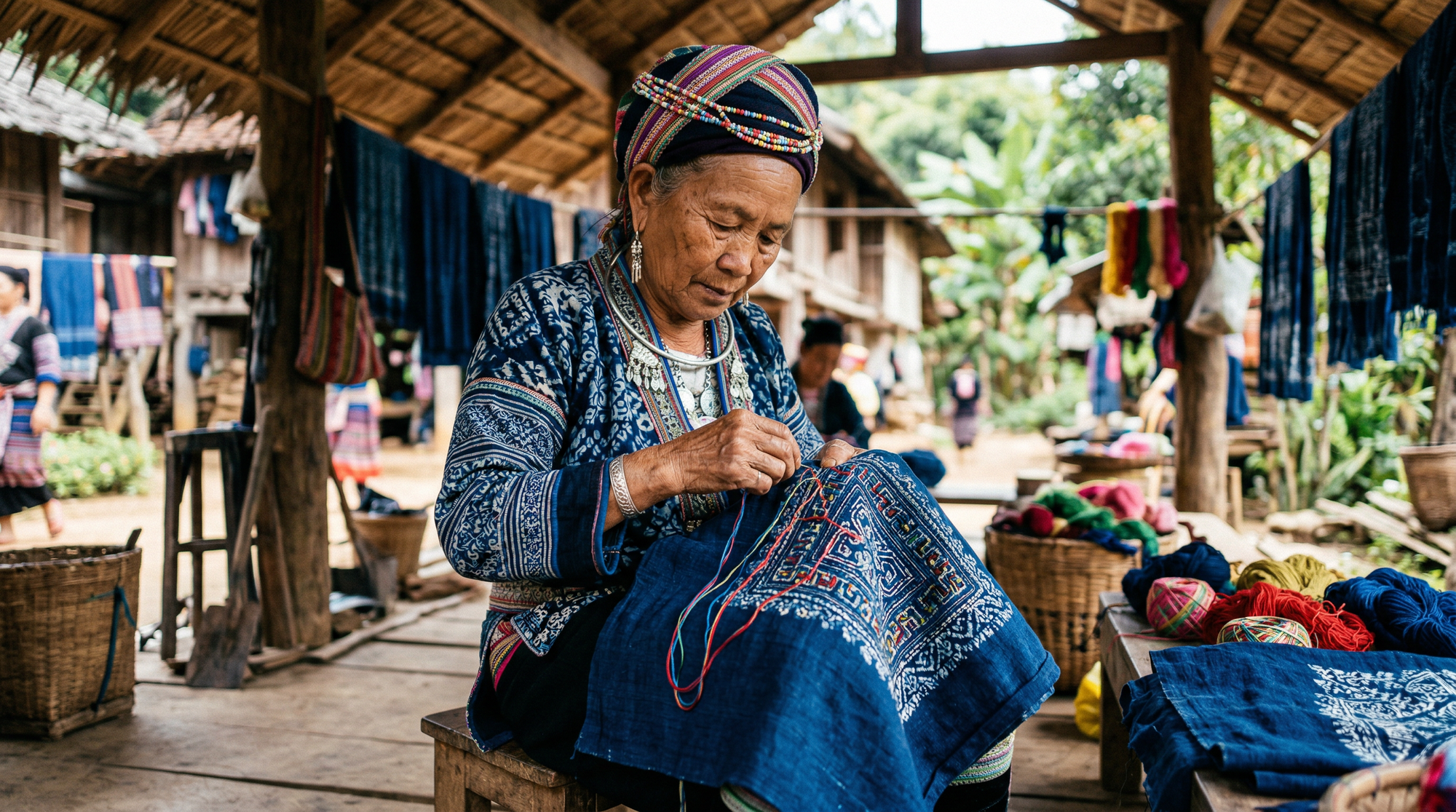
The textiles are what most visitors encounter first, and they are worth more attention than a market glance. Hmong traditional clothing is renowned worldwide for its vibrancy, complexity, and meticulous craftsmanship, serving as a clear visual indicator of sub-group affiliation. Blue Hmong women are famous for their dark indigo hemp skirts exquisitely patterned using the ancient technique of batik, while White Hmong women wear black or dark trousers and a tunic distinguished by an intricately embroidered silk or satin panel. Maehongsonholidays
The patterns are not random. They are a visual record of belonging, an encoding of community membership in colour and geometry. Buying a piece of Hmong embroidery is not buying decoration. It is acquiring an object that contains specific information about the person who made it and the community she belongs to.
A core social activity during the Hmong New Year is ball tossing, a courtship ritual where young men and women stand in two facing lines and toss a cloth ball back and forth, providing an opportunity for flirtation and finding a partner outside of one's own clan. Maehongsonholidays The Hmong New Year, typically in November or December, is one of the most vivid cultural events in the northern Thai highlands and is genuinely worth timing a visit around.
Three Communities, One Shared Situation
What the Karen, Akha, and Hmong share is not culture. Their cultures are as different from each other as they are from mainstream Thai society. What they share is a structural position : highland communities in a lowland state, ethnic minorities whose relationship to Thai citizenship, land rights, and national identity has been complicated since the Thai state began asserting control over the northern mountains in the mid-20th century.
The hill dwelling peoples have traditionally been primarily subsistence farmers. The mountain peoples are severely disadvantaged by comparison with the dominant Thai ethnic group. A Bangkok Post article noted that nearly a million hill peoples and forest dwellers are still treated as outsiders, since most live in protected forests. Wikipedia
This context does not make a visit to highland communities inappropriate. It makes understanding that context part of what a responsible visit involves. The people you meet in a Karen village or a Hmong market are not simply custodians of a colourful tradition. They are navigating a complex and often difficult relationship with the modern Thai state, with the tourist economy, and with the question of how to preserve what they are while living in a world that keeps changing around them.
What You Can Learn at the Lanna Folklife Museum
Before visiting highland communities, the Lanna Folklife Museum in Chiang Mai provides one of the best available introductions to the cultural context of the north, including exhibits on the highland peoples and their relationship to the broader Lanna civilisation. It is free or very low cost and can be covered in two hours. Going there first changes the quality of what you see afterwards.
FAQ
What is the difference between the Karen, Akha, and Hmong ? Three entirely separate peoples with different origins, languages, spiritual systems, and material cultures. The Karen are the oldest established community, animist-tinged-Buddhist, known for weaving and elephants. The Akha are deeply traditional, without a written language, defined by the Akha Way and the spirit gate. The Hmong are more recently arrived, carry a complex 20th century political history, and are known for their textiles and commercial activity.
Which highland community is easiest to visit from Chiang Mai ? The Karen villages in Mae Wang are the most accessible, roughly 90 minutes from the city. The 2-day eco-trek with Karen homestay near Doi Inthanon is one of the most well-structured visits available.
Is it appropriate to photograph people in highland communities ? Only with explicit permission, and ideally not as the primary purpose of the visit. The best encounters happen when the camera stays in the bag until a relationship has been established.
Where can I learn more about highland communities before visiting ? The Lanna Folklife Museum in Chiang Mai's old city is the best starting point. The Wikipedia article on hill tribes of Thailand provides a thorough factual overview including the political and legal dimensions.
When is the Hmong New Year ? Typically in November or December, at the end of the harvest season. It is one of the most vivid cultural events in the northern highlands and worth timing a visit around if possible.