

Reading time : 8 min | Updated : April 2026
There is a small tube that almost every person in Thailand carries somewhere on their body. In a pocket, in a handbag, tucked into a fold of clothing. It is about the size of a lipstick. It is filled with herbs. When life becomes too much, too loud, too fast, too heavy, they open it and breathe.
The yadom is not a perfume. It is not a wellness product in the contemporary sense of that word. It is medicine. Traditional Thai medicine, passed down through generations of healers, condensed into something small enough to carry with you everywhere and potent enough to change the quality of your next breath.
When you make your own, something shifts in how you understand it.
A City That Has Always Known How to Heal
Chiang Mai has been a centre of traditional healing for as long as it has been a city. The northern Thai herbal tradition draws on the surrounding mountains, which hold one of the most biodiverse highland ecosystems in Southeast Asia. Galangal, camphor, lemongrass, peppermint, kaffir lime, butterfly pea flower, ginger. These are not exotic ingredients. They are the plants that have grown in the valleys and forests around Chiang Mai for millennia, and the people of the north have been learning from them for just as long.

Traditional Thai medicine is not a system built on abstraction. It is a system built on observation. Generations of healers watched which plants reduced fever, which eased digestion, which cleared the lungs, which quieted the mind. They blended them into formulas that were tested across lifetimes and refined across centuries. The knowledge that lives in a traditional herbal recipe is not the knowledge of a single person. It is the accumulated knowledge of everyone who came before.
Sitting down to make a yadom in Chiang Mai is, in a small but real way, entering that continuity.
What the Yadom Actually Does
The yadom works through the olfactory system, the oldest and most directly emotional of the human senses. Smell is the only sense that connects directly to the limbic system, the part of the brain that processes emotion and memory, without passing through the thalamus first. This is why a particular scent can produce an emotional response before the thinking mind has had time to form a thought about it.
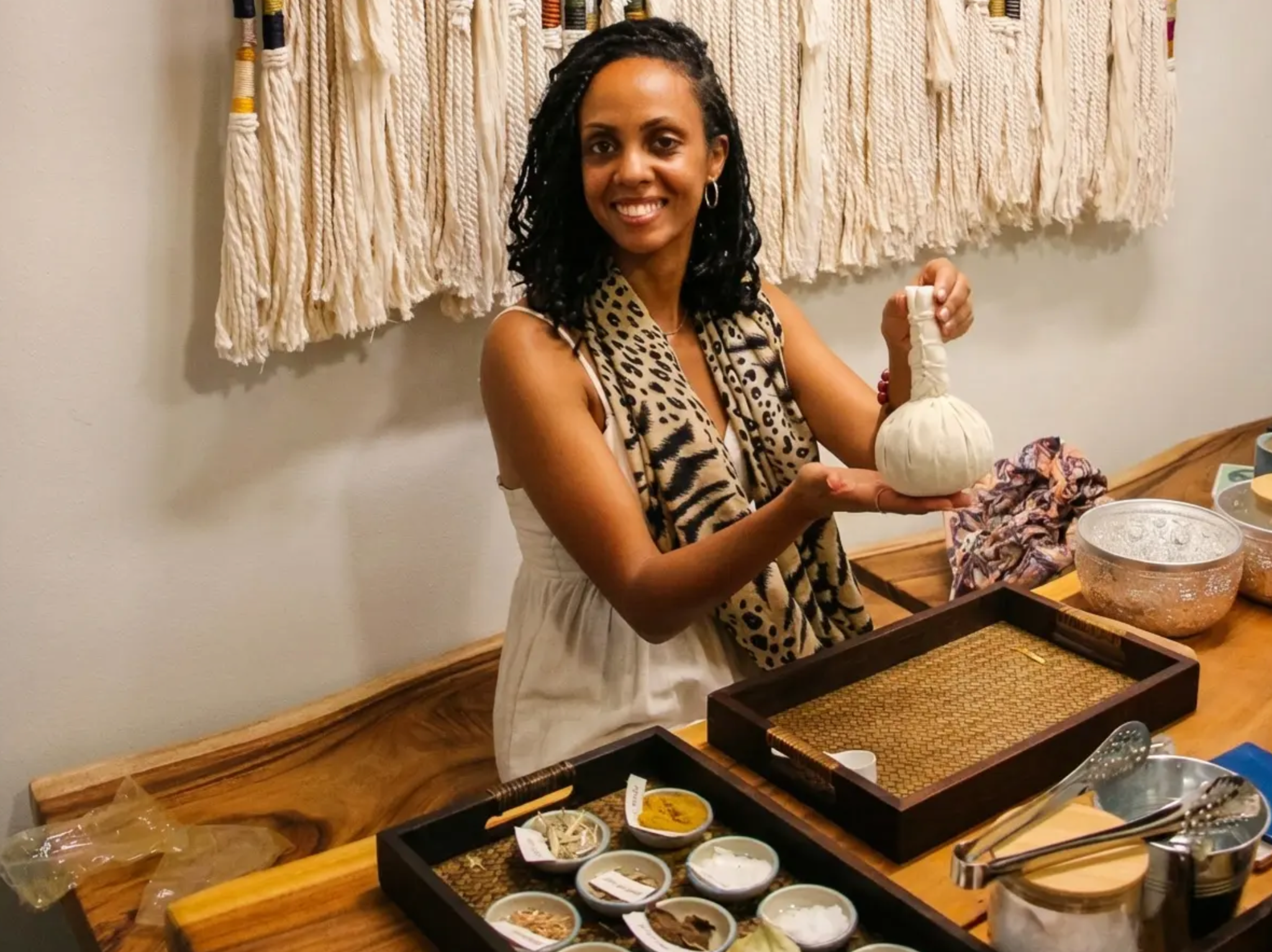
The herbs in a traditional yadom are chosen for specific effects. Camphor clears the airways and sharpens attention. Peppermint cools and calms. Eucalyptus opens the chest. Lemongrass lifts the mood. Kaffir lime grounds. Together, blended in the proportions of a recipe refined over generations, they produce something more than the sum of their parts: a moment of clarity, a reset, a breath that lands differently than the one before it.
Thai people use the yadom for headaches, for nausea, for fatigue, for stress, for the particular heaviness that accumulates in a day that has asked too much. They use it on public transport, in offices, in markets, on the side of roads. It is the most portable form of wellness that exists, and it works.
Three Ways to Go Deeper
The workshops available in Chiang Mai approach this tradition at three levels of depth, each building on the last.

The entry point is the Thai Yadom Herbal Inhaler Workshop, a focused one-hour session built around a single ancient recipe passed down by a master of traditional Thai medicine. You learn what each herb does, how the proportions work, and why the combination produces the effect it does. You blend your own inhaler by hand. You leave with something that will still be working for you weeks from now, every time you open it and breathe.
The middle path is the Thai Wellness Herbal Tea and Yadom Workshop, a two-hour session that adds herbal tea to the process. Using traditional ingredients including ginger, pandan, and butterfly pea flower, you build two custom blends targeted to your specific needs: digestion, stress, sleep, immune support. The tea and the inhaler together give you a more complete picture of how the Thai herbal tradition approaches the body as a whole system rather than a collection of separate symptoms.
The full immersion is the Integrated Herbal Journey, a three-hour experience that brings in a third practice: the herbal massage ball. A traditional Thai healing tool, the massage ball is a cloth bundle filled with herbs that is warmed and pressed into the body to release tension and stimulate circulation. You make your own, learning the herbs that go inside and the principles behind how they work. You leave with three things you made by hand from traditional recipes: something to breathe, something to drink, something to press against the places that are holding too much.
What Happens When You Learn to Read a Plant
There is a particular kind of knowledge that can only be acquired through the hands and the nose. You can read about galangal in a book. You can see photographs of it. But the moment you hold the fresh root, break it open, and breathe in what lives inside it, the knowledge moves from the head to somewhere more permanent.

This is what these workshops do that no amount of reading can replicate. You work with the actual herbs. You smell each one separately before you smell them together. You understand, through direct experience, why a particular combination works: because you can feel it working on your own nervous system in the moment of making.
The process of learning is slow and sensory. It asks for a different kind of attention than the attention most of us practise in daily life. Not the rapid scanning attention of someone moving through a busy day, but the settling, patient attention of someone trying to understand something that is worth understanding.
This is, it turns out, its own form of rest.

Smell as a Path Back to Yourself
The yadom tradition understands something that Western wellness culture has been slowly rediscovering: that the way back to yourself often runs through the body, and the body is most reliably reached through the senses.
When you open a yadom and breathe, the effect is immediate. Not metaphorical. Not aspirational. The camphor reaches the olfactory receptors, the nervous system responds, and something in the quality of the present moment changes. The thought that was spinning slows down. The chest that was tight loosens slightly. The breath that was shallow finds a little more room.
This happens in seconds. It has been happening, in Thailand, for centuries.
Making your own yadom in Chiang Mai means you carry that knowledge home with you in the most literal sense possible. The small tube you blended by hand, from a recipe older than most buildings in your city, fits in any pocket. Every time you open it, the herbs do what they have always done. The tradition continues.

What These Workshops Are Really About
On the surface, these are craft experiences. You learn something, you make something, you leave with an object.
Underneath that, they are something more like an argument. An argument that the knowledge of how to take care of yourself is not complicated, not inaccessible, not the exclusive property of specialists. That it lives in plants that have been growing in the hills above Chiang Mai for longer than anyone can remember. That it can be learned in an afternoon. That the body already knows how to respond when you give it what it needs.
There is something genuinely moving about sitting down with dried herbs in front of you and following a recipe that a healer passed to a student who passed it to another student across generations until it arrived, this afternoon, in your hands.
The knowledge did not change. Only the person learning it.

Practical Notes
The three workshops are available at different price points and durations to suit the time and depth you are looking for. The yadom inhaler session takes one hour and costs $27. The herbal tea and yadom workshop runs two hours at $51. The full integrated herbal journey covers three hours for $69.
All sessions are suitable for complete beginners. Materials are provided. The herbs used are traditional northern Thai varieties, sourced locally. Everything you make goes home with you.
Book in advance. These are small, intimate sessions and availability fills quickly, particularly during the high season from November to February.

FAQ
What is a yadom ? A yadom is a traditional Thai herbal inhaler, a small tube filled with a blend of medicinal herbs including camphor, peppermint, eucalyptus, and other plant extracts. It is used throughout Thailand for headaches, fatigue, nausea, stress, and general wellbeing. You will see them everywhere in Thailand, in pockets, on dashboards, next to cash registers.
Do I need any knowledge of herbs or traditional medicine ? None at all. The workshop is designed for complete beginners and the instruction covers everything you need to understand what you are making and why.
How long does a yadom last after I make it ? A well-made yadom keeps its potency for several months when stored properly, away from heat and direct sunlight. The herbs continue to release their compounds each time you open the tube.
Can I customise the blend ? Yes. The workshops teach the traditional recipe as a foundation, but the tea blending session in particular allows you to select combinations based on your specific needs.
Is this suitable for children ? The herbs used are natural and non-toxic. For younger children, check with the provider at the time of booking regarding age guidelines for the specific session.