
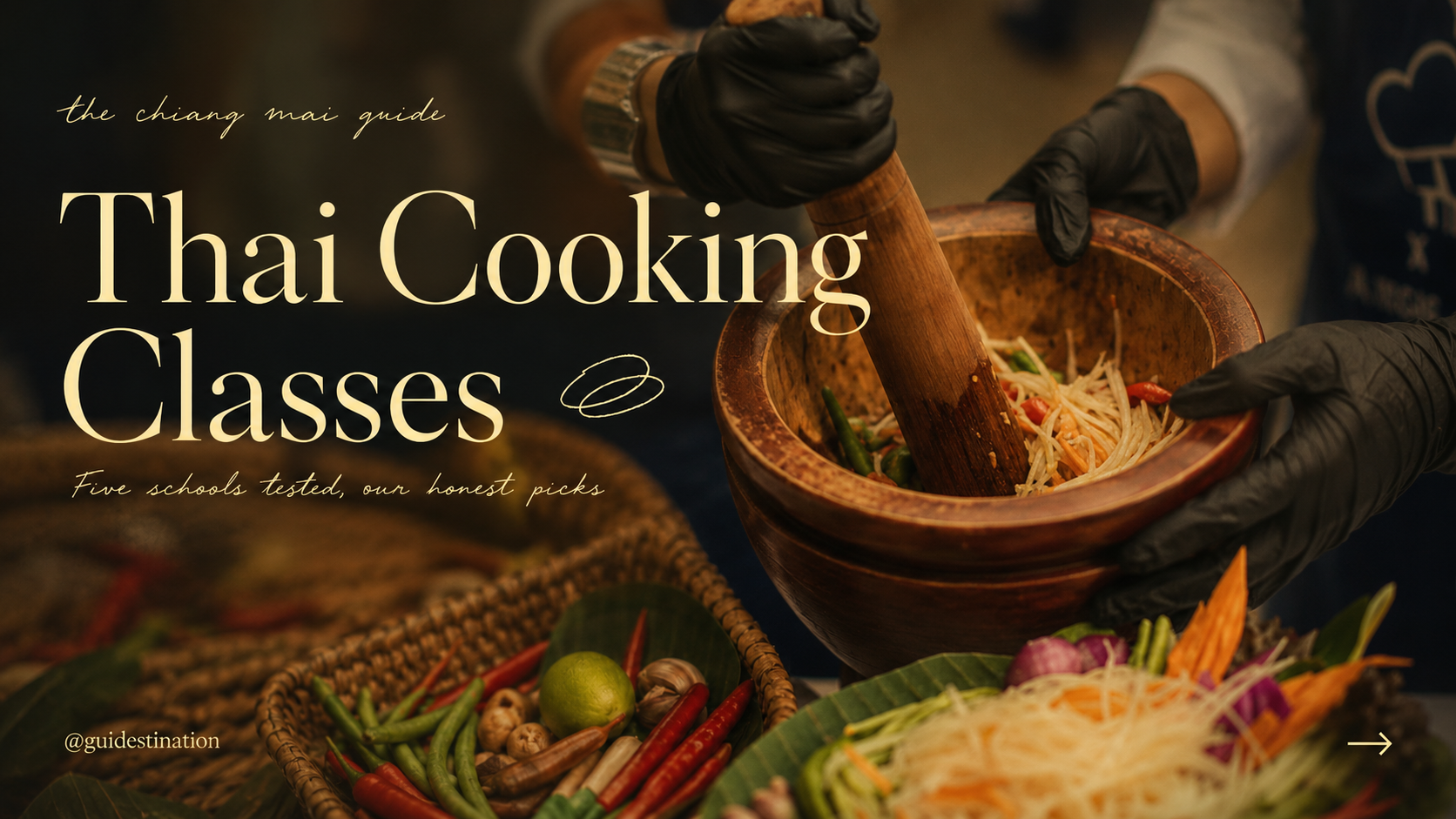
The first time we tasted a real khao soi in Chiang Mai, two things hit us. One, the version we'd been eating for years back home tasted like nothing. Two, we wanted to learn how to make it ourselves.
That's exactly what a Thai cooking class in Chiang Mai gives you. Not a quick touristy workshop, but a proper half day (sometimes more) figuring out how this cuisine actually works. With its ingredients you won't find anywhere else, its mortar-and-pestle techniques, and that obsession with balancing the four core flavors.
We've tested 5 schools in and around Chiang Mai over the past two years. Here's our honest comparison, with what we loved and what made us cringe.
Why Take a Cooking Class in Chiang Mai Instead of Bangkok
Chiang Mai cuisine isn't Bangkok cuisine. That's the number one mistake travelers make when they show up in the North expecting pad thai on every corner.
You're in the former Lanna kingdom here, with a cuisine shaped by Burma, Yunnan China and Laos. The signature dishes: khao soi (coconut curry noodle soup), sai ua (Northern Thai herb sausage), nam prik ong (tomato-chili dip), kaeng hang lay (Burmese pork curry). You won't learn those in a Bangkok cooking class. You learn them here.
Second reason: density of options. Chiang Mai has more cooking schools per square kilometer than any other city in Southeast Asia. As a result, quality has gone up and prices have stayed low. Expect 700 to 2,800 THB per person depending on the format, versus 1,500 to 5,000 THB in Bangkok for an equivalent experience.
Third reason: the countryside. Many Chiang Mai schools are located on the outskirts, on farms surrounded by rice paddies, 15 to 40 minutes from the center. Which completely changes the experience compared to a cooking class in a downtown basement. You cook with an actual view, not under fluorescent lights.
What Separates a Good Class From a Mediocre One
Before the comparison, two words on what we look for when evaluating a school. Because we've seen everything, from genuinely great to pad-thai factory.
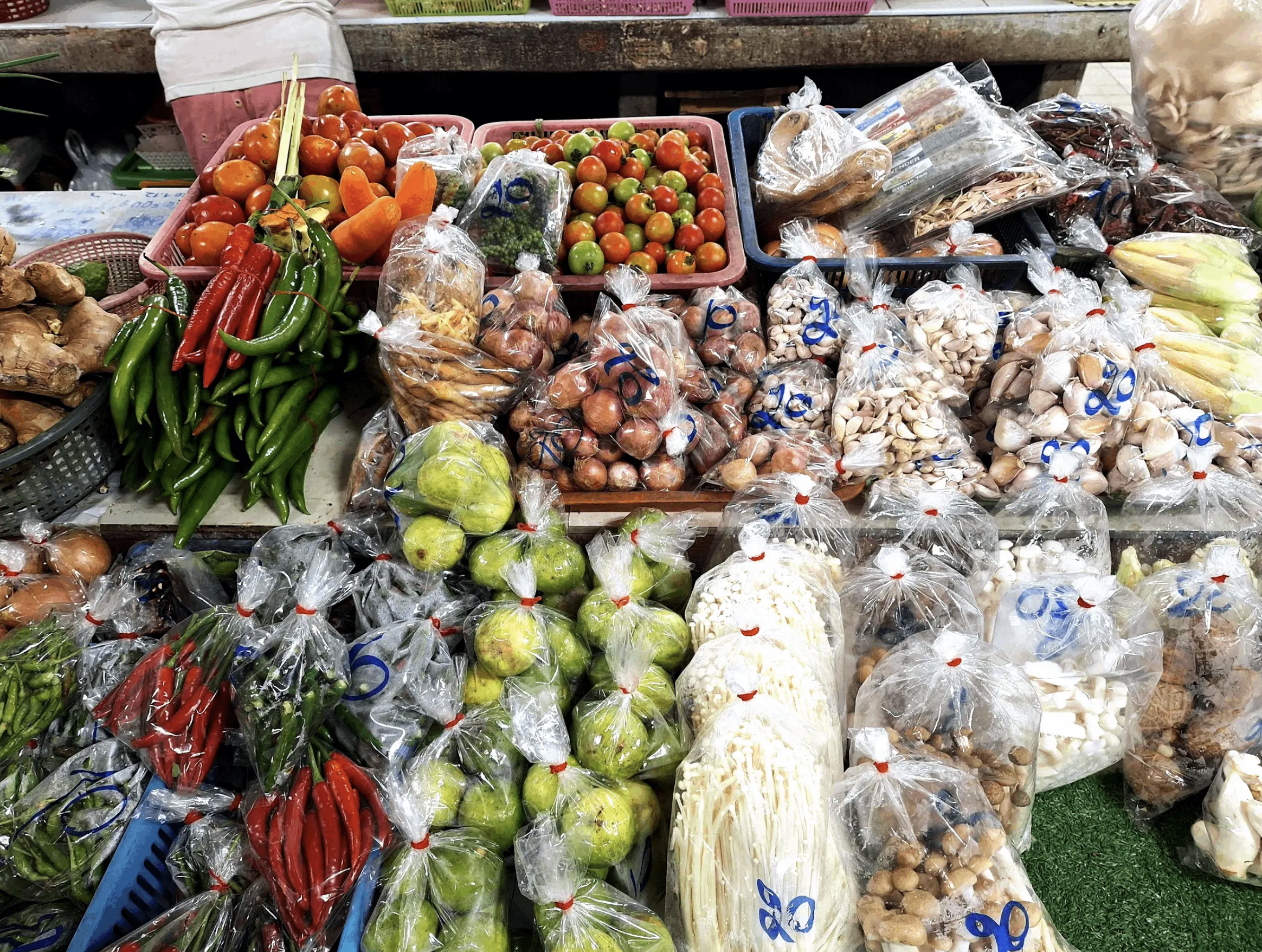
The market visit is non-negotiable. A serious class always starts with 30 to 45 minutes at the local market. Not to tick the "authentic experience" box, but because that's where you learn to tell galangal from ginger, pick a good curry paste, identify fresh herbs you'll never find back home. Skip that step and you're cooking blind.
Dishes have to be reproducible at home. A good teacher systematically explains which substitutions to make once you're back: kaffir lime leaves replaced by lime zest, coriander root by stems, fish sauce by soy sauce for vegan adaptations. Otherwise the recipe booklet ends up at the bottom of a drawer.
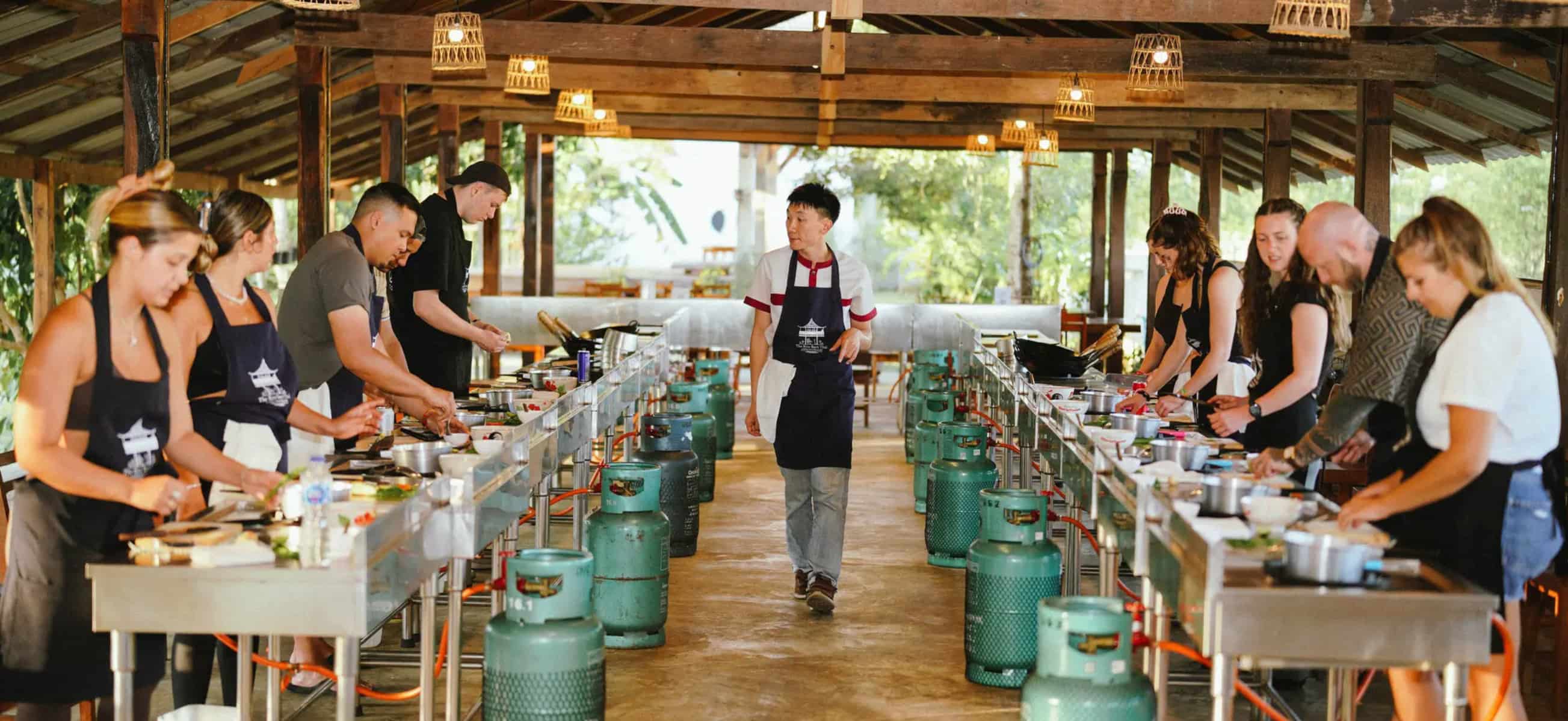
Individual cooking station = real learning. When each participant has their own wok and mortar, the pedagogy is night and day. You're not watching the teacher do everything while you take notes. You're doing it yourself, getting corrected, building muscle memory. The best schools we tested all have individual stations.
Real Lanna food, not just tourist menu. If the menu is only pad thai + green curry + tom yum + mango sticky rice, you're in a school calibrated for the rushed tourist. Look for ones offering khao soi, sai ua, nam prik, kaeng hang lay. That's the signal of a real Northern Thai school.
Our Top 5 Cooking Classes in Chiang Mai
We ranked these based on clear criteria: teaching quality, Lanna authenticity, value for money, atmosphere. No absolute ranking, the best class depends on what you're after.
1. The Countryside Immersion (Our Editorial Favorite)
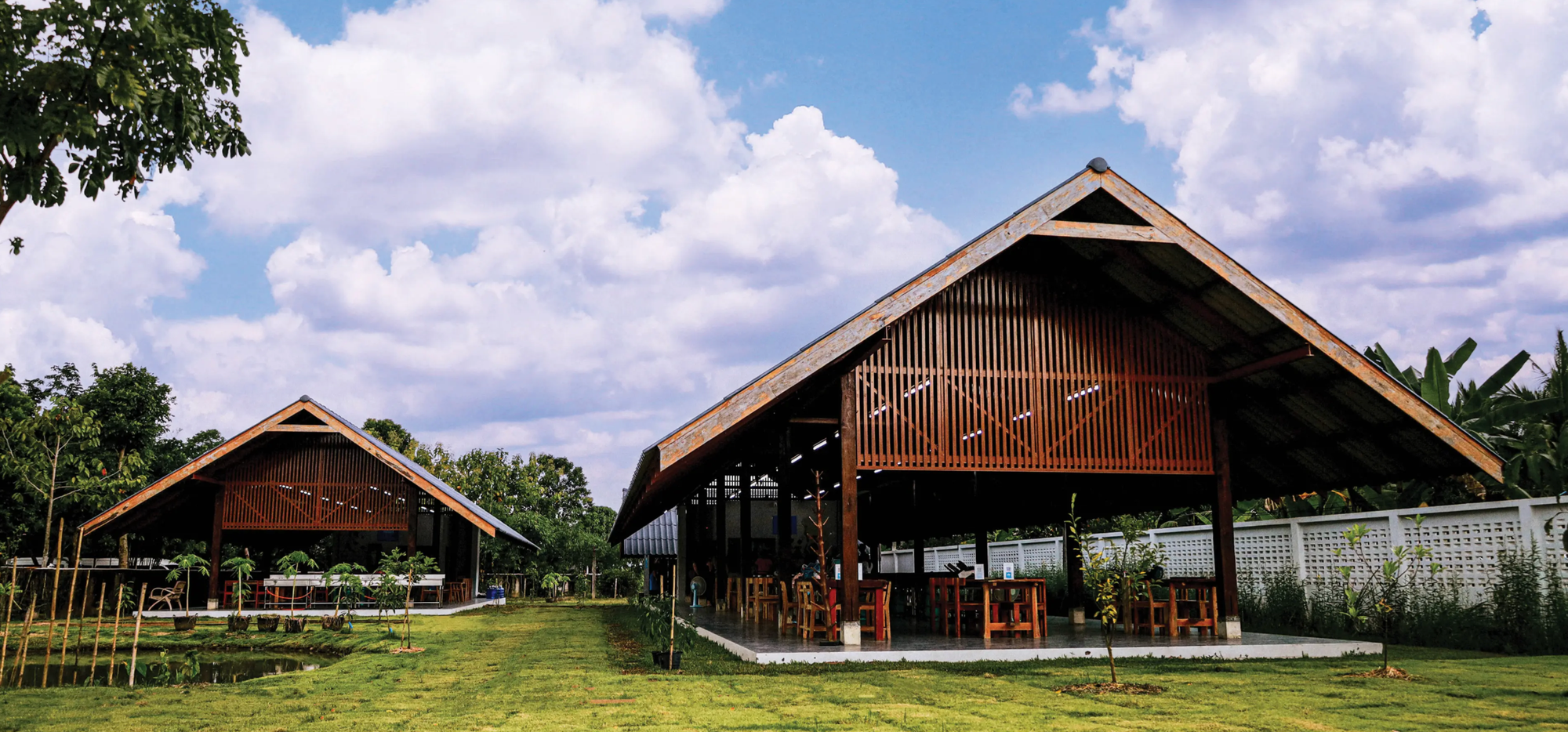
About 30 minutes from the center, in a small village surrounded by rice paddies. The class takes place in a traditional wooden hut, no modern building in sight, just rice fields and a few wandering chickens.
- Duration: 6 hours (9am to 3pm, or 4pm to 9pm evening session)
- Price: around 1,000 THB per adult, 500 THB for children 4-11
- Group size: maximum 10 people
- Included: free shuttle from the old city, local market visit, all ingredients, digital recipe book sent after the class, complimentary herbal drink
- Best for: digital nomads wanting a full day off, families with kids, slow travelers
What makes this one different from a standard class: you're not in a school kitchen, you're in an actual Thai home. The chef talks about her family, how her parents farmed rice, and you eat under a wooden veranda with a view over the fields. Vegetarian, vegan and halal options available (specify at booking).
The honest downside: it's 6 hours, so it eats your whole day. If you want something quick between two meetings, this isn't the right choice. But that's exactly why we love it. Bookable on Guidestination: Countryside Thai Cooking Experience.
2. The Half-Day Farm Class (Most Efficient for Digital Nomads)
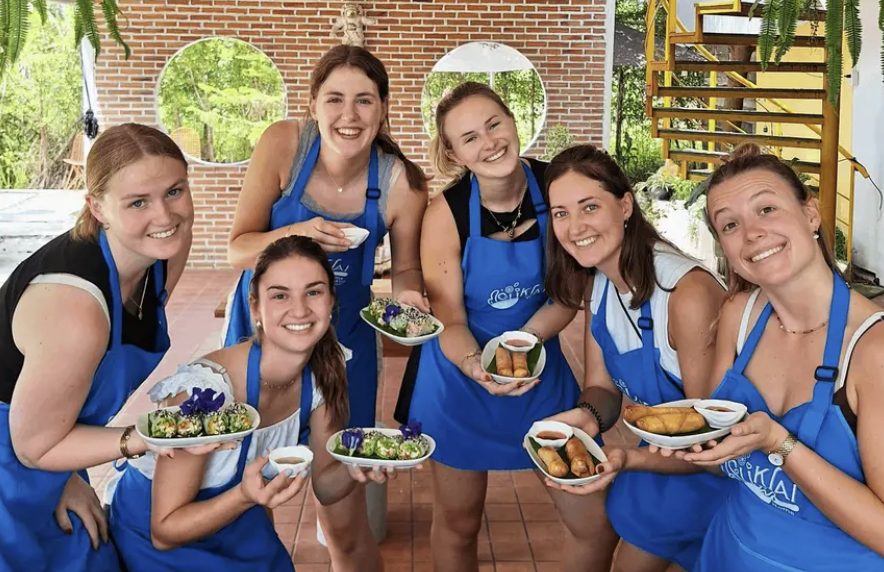
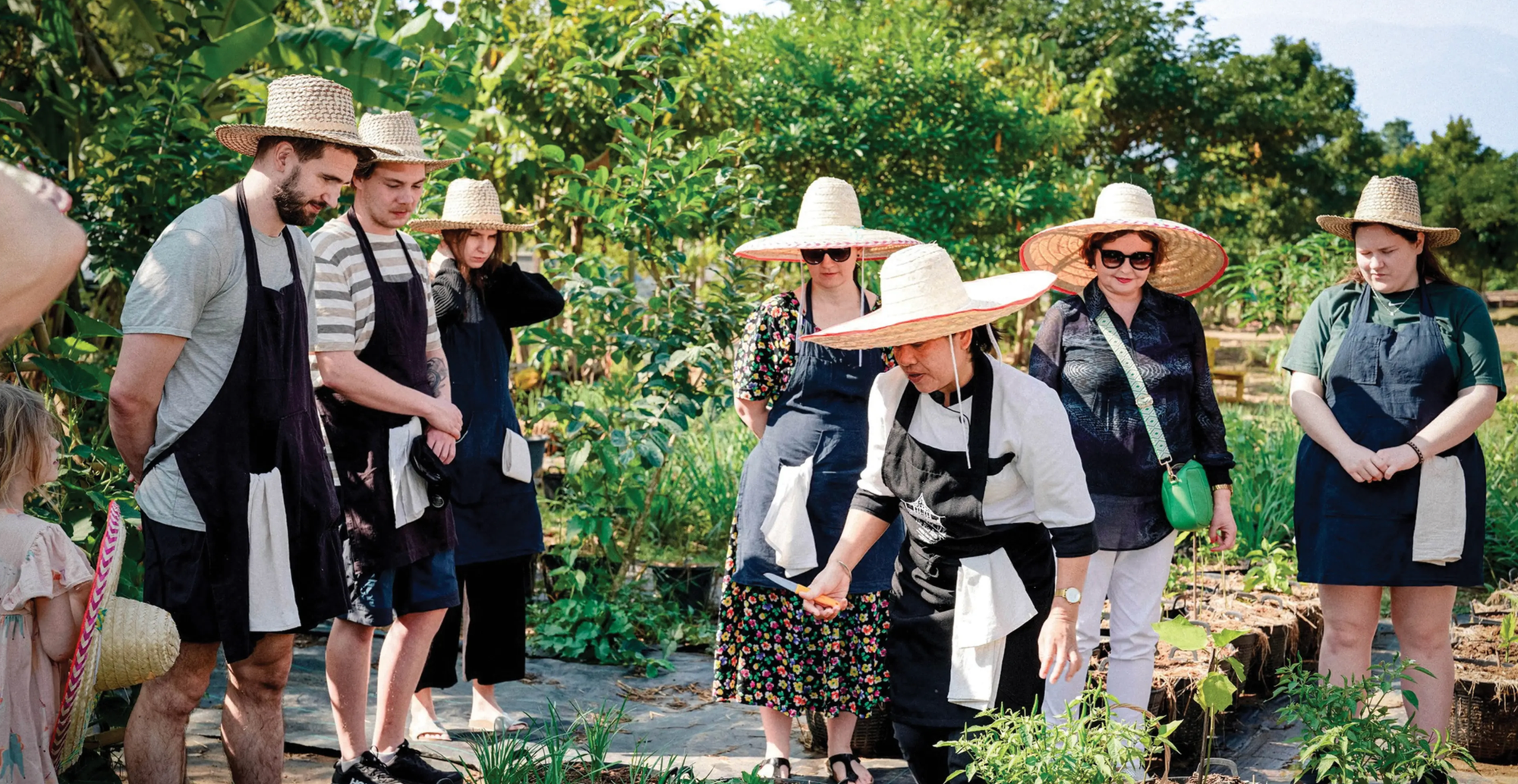
15 minutes from the center, on a farm with rice paddies, an organic herb garden and natural ponds. Half-day format that leaves you part of the day to work or do something else. Three time slots (morning, afternoon, evening) to fit your schedule.
- Duration: 5 hours (3 sessions to choose from)
- Price: around 900 THB per person
- Group size: 2 to 20 people
- Included: round-trip transfer from Chiang Mai, local market visit, color recipe book (digital), coffee and tea
- Dishes: 5 dishes prepared in a half day
- Best for: travelers with tight schedules, anyone wanting a serious class without blocking the whole day
The strong point: individual cooking station for each participant. You have your own wok, your own mortar. Pedagogically, this changes everything for beginners. The organic herb garden is worth the detour too: you smell, touch, taste the fresh leaves. It sounds anecdotal but it's what makes you actually know what a kaffir lime leaf is by the end of the day.
Same provider as the full-day version below, just shorter format.
3. The Full-Day Farm Class (For Serious Cooks)
Same farm location, same setup as the half-day class, but extended to a full 7-hour day with 6 dishes prepared from scratch. The added time is mostly spent on curry paste making from scratch in the mortar, which is where the real Thai cooking knowledge lives.
- Duration: 7 hours
- Price: around 1,200 THB per person
- Group size: 2 to 20 people
- Included: digital color recipe book, transport on request
- Dishes: 6 dishes including homemade curry paste
- Best for: amateur cooks wanting to really learn, anyone who wants to bring back a real cooking repertoire
If you're hesitating between the half-day and full-day version of this school, here's our honest take: the full day is worth it if you cook at home regularly. Making your own curry paste once teaches you more than 10 watch-the-teacher demos. If you cook occasionally and just want a fun day, the half day is enough.
4. The Vegan Private Class (Best for Plant-Based Travelers)
A private cooking class run by an experienced vegan chef in central Chiang Mai. Compact format (2 hours), but fully private, meaning the chef adapts everything to your level and pace.
- Duration: 2 hours
- Price: around 1,500 THB per person
- Group size: up to 10 (private, so usually 1-4 people)
- Included: all ingredients, equipment, welcome drink, the meal you prepare
- Best for: vegans, vegetarians, anyone wanting a flexible private experience
The menu rotates between 3 set formulas. You can pick the one that appeals to you:
- Formula A: Vegetable spring rolls, tempeh with black pepper, vegan spicy soup with mock shrimp and mushrooms, mango sticky rice
- Formula B: Tofu satay, vegan cashew "chicken" stir-fry, green curry with vegan chicken, banana in coconut milk
- Formula C: Papaya salad, tofu pad thai, vegan coconut "chicken", pumpkin in coconut milk
The 2-hour format is the only real limitation. You won't get the deep cultural immersion of a 6-hour countryside class. But for travelers with dietary restrictions who often get told "we'll adapt for you" in regular classes (and end up eating a sad version of the menu), having a properly designed vegan class makes a huge difference.
5. The Cooking + Elephant Sanctuary Combo (Best Bang for Your Day)
Our most-recommended option for travelers with only one free day. This 11-hour excursion combines a Thai cooking class near Chiang Mai's Grand Canyon with an afternoon at Joy Elephant Sanctuary, an ethical sanctuary in the jungle nearby.
- Duration: 11 hours (a real full day)
- Price: around 2,700 THB per adult, 2,000 THB for children 4-11
- Group size: up to 25 people
- Included: hotel pickup and drop-off, air-conditioned transport, English-speaking guide, all cooking ingredients, lunch, elephant food, traditional Karen clothing, accident insurance, digital recipes, photography service
- Best for: travelers with limited time wanting to combine two iconic Chiang Mai experiences, ethical animal welfare conscious visitors
A word on the ethical angle since it matters: this is not a riding sanctuary. No bathing the elephants, no contact, no forced interactions. The philosophy is clear: observe the elephants from a respectful distance, prepare their food, watch them move and forage in their natural environment. You wear traditional Karen clothing, you spend time with the staff learning about elephant behavior, and you let the elephants be elephants. That's the kind of ethical animal tourism we recommend, the rest we don't.
The cooking part of the day happens near the Grand Canyon, with a fun atmosphere and authentic dishes including vegan and gluten-free options. You'll end the day relaxing by a waterfall with an herbal tea. Bookable on Guidestination: Chiang Mai Ethical Elephant Sanctuary and Thai Cooking Class.
How Much It Actually Costs
The cooking class market in Chiang Mai has a fairly wide price range depending on format:
- Half-day basic class: 700 to 1,000 THB for 3-5h, 4-5 dishes, small to medium groups
- Full-day class: 1,200 to 1,500 THB for 6-8h, 6-7 dishes, smaller groups, more depth
- Specialty class (vegan, private): 1,500 to 2,000 THB for compact private format
- Combo experiences (cooking + sanctuary/temple/excursion): 2,500 to 3,500 THB for 10+ hours, full transport included
What's almost always included: market visit (most classes), all ingredients, equipment, the meal (you eat what you cook), one drink, a digital recipe book.
What's rarely included: alcoholic drinks, tips (not mandatory in Thailand but appreciated, 50 to 100 THB per person), eventual taxi if the school is on the outskirts and you don't take the shuttle.
Our observation: the difference between a 900 THB class and a 1,500 THB class isn't really in teacher quality (Thai instructors are generally excellent), it's in the setting, group size, individual attention, and depth of content (especially curry paste from scratch vs pre-made). Up to you to decide what matters for your trip.
How to Pick the Right Class for You
If you're hesitating between several schools, here's our quick decision matrix:
You're a digital nomad and want a full day off → the 6-hour countryside immersion. Best vibe-to-price ratio in the entire selection.
You have a packed schedule (work, meetings, other activities) → the half-day farm class with individual stations.
You actually want to learn to cook, not just have a good time → the full-day farm class with curry paste from scratch.
You're vegan or have strict dietary needs → the private vegan class. Worth the slightly higher price for the dedicated menu.
You only have one free day and want maximum experience → the cooking + elephant sanctuary combo. Two iconic Chiang Mai experiences in one day, with transport handled.
You're traveling with kids → the countryside immersion or the cooking + elephant combo. Both have child rates and very suitable settings.
According to the TAT (the official Thai tourism authority at tourismthailand.org), cooking classes are among the top activities for foreign visitors to Chiang Mai, just behind temples and elephant sanctuaries. Demand is strong, especially during high season (November to February). We recommend booking at least 3-4 days in advance, and ideally 1-2 weeks during Yi Peng and the holiday period.
FAQ: Everything People Ask Us About Cooking Classes in Chiang Mai
Do I need to know how to cook to take part?
No, not at all. Most participants have never touched a wok in their life. Teachers are used to total beginners and their teaching is calibrated for that. What matters is your curiosity, not your technical skills.
Can I do a vegetarian or vegan class?
Yes. Most schools adapt the menu on request (tofu instead of meat, soy sauce instead of fish sauce). For strict vegans or anyone who wants a properly designed plant-based experience rather than a "we'll adapt" version, the dedicated vegan private class is the right call.
How long does a typical class last?
Three main formats: half day (3-5 hours, 4-5 dishes), full day (6-8 hours, 5-7 dishes, market + class + meal), combo/immersion (10+ hours with a second activity included). Half day remains the most popular for a first class.
Is the market visit really worth it?
Yes, completely. It's where you learn to recognize fresh galangal, choose curry paste, identify the herbs you'll use later. Schools that skip the market visit (some downtown ones do) sell you a fun afternoon but not a real cooking experience. We'd avoid those.
Should I take a class early or late in my trip?
Our advice: mid-trip. Not too early because you haven't tasted enough Thai dishes to contextualize them. Not too late because you want to be able to try the learned dishes on the street after class, to compare. Ideally day 3 or 4 of a 5-7 day stay in Chiang Mai.
Is the elephant sanctuary in the combo actually ethical?
Joy Elephant Sanctuary explicitly excludes elephant riding and bathing from its program. Activities focus on observation, food preparation, and respectful distance. That matches the criteria we use to recommend ethical sanctuaries (no riding, no shows, no forced contact). Read more on what makes an elephant experience ethical in our dedicated article on the topic.
Final Word: One of the Best ROI Activities in Chiang Mai
Out of the dozens of activities we've tested in Chiang Mai, few come up as often in positive feedback as cooking classes. It's one of the rare activities where you walk away with a real, usable takeaway: your recipes, your confidence, and often friends met during the day.
Our practical recommendation: don't book the first class that pops up on Google. Think about what you actually want (serious learning or fun atmosphere, city or countryside, half day or full day, solo or combo) and choose accordingly. The 5 schools we covered above all serve different needs.
If you want our pre-filtered selection, we've done the sorting for you on Guidestination, with only schools we've personally tested and approved. And if you want help picking based on your specific profile, drop a comment with what you're looking for, we'll respond.
Team note: article updated May 2026. Prices listed are those observed at the time of writing and may vary. Always check the current rate on the activity page at booking time.